Showing posts with label grim dream. Show all posts

Saturday, 2 November 2019

Mysterious Temple


Ha! I bet that you totally forgot about my blog… I apparently did. A year and a half of silence would suggest that anyways.

The illustration below was actually made over one and a half year ago, which could confirm that I haven’t drawn anything since a looong time. But that’s not true, I swear. I’ve been just extremely busy with projects I cannot share with you… yet.

I’ll be brief (just as a busy person like myself should be).


In the beginning, I made a few concept sketches. Not real pieces of art, I know. But don’t lose hope:

Outlines drawn in pencil:

Some details in waterproof ink:


The whole building and the foreground were masked with masking fluid to protect these areas from being painted over with very liquid paint (“wet on wet” technique). Mountains were salted to achieve these textures:

Working on the sky with watercolor paint mixed with gum arabic. Previously masked areas were painted slowly and carefully:

Hmmm… looks almost like the previous step. Maybe I just wasted my time, but I actually added some extra precise shadows and highlights with ink and dense white watercolor paint:


Wednesday, 14 March 2018

"Magician's Palace" - Designing Imaginary Architecture

Hi there! In snowy and cold winter days like these, there’s nothing better than warm tea near the burning fireplace. As I don’t have a burning fireplace (or any other fireplace for that matter), warm tea near the computer has to suffice.

So! Here is the last of the four “case studies” but just one of the whole mass of drawings made for a course in designing imaginaryarchitecture. The concept process behind this design has been described in the course and below you can see the drawing process. This illustration is called “The Magician’s Palace” and the form of the building is strongly influenced by gothic cathedrals.

1.      Well, an expression “concept sketch” may be too generous, but this tangle of lines really helped me to capture the idea.


2.      Just a few fine, accurate lines, which will determine the size of the building on a large piece of paper.


3.      Sketches of details, which I wanted to capture as soon as possible before I forget them (I avoid using reference photos while drawing architectural objects).


Repeating the previous step in ink with “copying” repeatable elements. I’ve been using here the same waterproof Faber-Castell pens, size S. Actually, if I could find size XS, it would be even better.


4.      Further delving into details… and a moment of doubt. It’s going to take a looooong time before…


5.      …finish!

Well, it’s not the real finish yet. Below you can take a look at a short video, where I’ve been painting it with watercolors in sepia tones.


Keep warm!

Wednesday, 7 October 2015

A Short Interview


Last week I was aked to share on my blog a little more information about me as an illustrator/painter. I got 5 tricky questions (just kidding) from a fellow artist Patience Brewster . Hopefully the answers are informative and who knows, maybe even interesting :)


1. As a child, do you recall a significant moment when you felt truly affected or inspired by any particular artwork or artist?
I don't think there was such a specific moment. Almost since I was born I've been constantly surrounded by books about art and I really loved to browse through them. My favorite ones were those about Old Masters:  Leonardo da Vinci, Albrecht Dürer and Giovanni Battista Piranesi. I have a  mathematical brain, so complicated designs of Piranesi's prisons and technical thoughts of da Vinci made an enormous impression on me. 


2. As an artist, what do you hope to convey with your work?
I'm fairly introverted, so my personal works are results of an inner pressure to capture what's happening in my mind. Especially in the past I loved to retreat into my inner world and imagine wandering through unknown realms and fantastical buildings. Painting was helping me to make them more "touchable" and real somehow. It may sound kind of egoistically, but I wasn't thinking about potential viewers back then. 


Nowadays personal projects  are largely sidelined in favor of commissioned artworks and in these cases I'm just making the best illustrations I can.

3. What memorable responses have you had to your work?
Most of responses I get are really worth remembering so I regret I don't have a better memory...
Probably the most (literally) memorable response is a tattoo based on my "Butterflies Tree", which one brave girl have on her back. She sent me a photo. Impressive!
In general it's really uplifting when my works are perceived as useful somehow.  For example when they take someone on a trip to imaginative places and help to forget about real-life problems for a while. 
Recently I was really glad to receive this comment: "There's a stark, grim chill present in your work that feels almost like Dr. Seuss, Edward Gorey and Edgar Allan Poe had a baby."

4. What is your dream project?
One of them is related with my personal paintings and it's kind of secret :) 
The second one would be making environment and architectural designs for some big projects: movies or complex video games. It would be great to see how, in cooperation with other specialists, ideas initially captured on two-dimensional sheets of paper are getting alive.


5. What artists, of any medium, do you admire? (Famous or not!)
My favorite painter was, is and always will be Zdzisław Beksiński. Actually his paintings inspired me to study Architecture (just like he did). Moreover on my list there are previously mentioned Old Masters. Finally I must also name Caspar David Friedrich and Lars Lerin due to their technical skills and an unique atmosphere in their works.

Thursday, 20 August 2015

Female Portraits


How about making an exercise from painting female characters with watercolors? Yaaay!

To be honest watercolors aren't the easiest technique of making portraits. Drawing realistic people requires a very high level of accuracy, while watercolor technique is quite often perceived as series of "controlled accidents". When I googled "watercolor portraits", the vast major of searching results presented a very painterly style - sort of unfinished faces with colorful splashes around them. But the good news is that there were also a few extremely accurate artworks! 

This exercise was made in a way I usually paint buildings. The only difference was that this time I decided to follow strictly photo references (most of my buildings are painted totally from imagination). Special thanks to stock models: http://faestock.deviantart.com/ http://nastiaosipovastock.deviantart.com/  http://mirish.deviantart.com/ and http://chirinstock.deviantart.com/ !


The first step is a pencil sketch. The more accurate it is, the easier it will be to paint over it with watercolors. Tool: a mechanical pencil (0.5 mm, lead hardness H) - it should prevent from smearing. Luckily I chose yellowish paper, so the coffee stain is almost invisible :) 

To achieve a skin color I mixed yellow and red in different proportions along with adding different amount of water to it. For shadows I was also adding a little bit of violet. This brush appeared to be very useful. I used it for the whole work (except the background and some clothes):


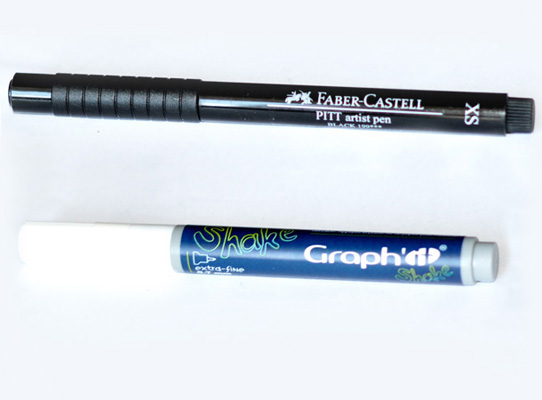
Just as in case of drawing buildings, I used a thin waterproof pen (size XS) for making contours. Metal details were highlighted with a white opaque marker. I was using it for the first time so I had no idea what kind of results should I expect. For me it's like a very thin corrector (0.7 mm):


During such exercises you probably won't have an opportunity to fully express your creativity or move into the world of imagination, but hopefully it will improve your attention to details, proportions and light. Strongly recommended from time to time!


Friday, 22 May 2015

OLD SCHOOL


"One always begins to forgive a place as soon as it's left behind; I dare say a prisoner begins to relent towards his prison, after he is let out."

Charles Dickens, "Little Dorrit"


The title of this entry can be a bit misleading, I know. It's not at all about an "old school style", but about an old building of my high school.

When I was a little girl I really  wanted to learn there. You know that old saying: "be careful what you wish for, it might come true"?

Originally the building was designed  as a casino, but after World War II it was turned into a school. I guess that I would have much more fun in a casino...

That's how the drawing was made:


1. Trying to capture correct proportions. Sketching existing buildings is much more time consuming than sketching those imagined (at least in my case). Personally I like to use mechanical pencils 0.5 for such tasks.


2.  Watercolors - this step appeared to be even more time consuming than the previous one. A dangerous thought emerged in my head "Oh, I'll never finish it"...


3. ...so I decided to eat something. Of course it postponed the moment of finishing the work, but also saved the painting from destroying.


4. Getting back with new forces! Yes, now it looks truly idyllically... but don't be fooled by appearances ;)

Friday, 20 March 2015

About Drawing Classes...


"The peculiarity of my temper is, ma'am, that I won't be swallowed up alive."
Charles Dickens, "Little Dorrit" 

Sometimes I'm asked about "a few tips on drawing buildings" or "a fast way to learn perspective rules". The only valuable "fast tip" which comes to my mind in such cases is "TAKE ART CLASSES". Yes, for me it's the best way to gain a solid base in drawing. 

Before I started to write this article I made a little Google-search to check out what other people think about attending such classes (just in case my notion was totally contradictory to the generally prevailing). It turned out, that there are surprisingly many (though maybe not SO surprisingly many) opinions maintaining, that attending drawing courses is quite redundant. Why? Because everything can be learned from YouTube videos and internet tutorials totally for free. I decided to test it (oh, how mistrustful I am) and typed "How to draw a cockroach". The browser found over 10.000 results... in a split second... I had no more questions.

Anyway I'm going to insist on my point of view and bring forth those benefits of real-life art classes, which you won't get from Internet:

1. Professional feedback (i.e. comprehensive, constructive criticism) about your own work. The truth is that you may make mistakes/encounter problems other than  the person presenting his/her own work on the Internet. A skillful teacher can notice  weaknesses, which you could never notice yourself, or at least would discover after a longer time.

2. High efficiency. Apparently it's best to learn from your own mistakes, but... mistakes of other course participants can also be very "developing". When you're watching your colleague getting remarks, a metaphorical warning light turns on in your brain. Thereby you become aware of many errors before you'll make them yourself. What a time saver! Initially, pointing out errors publicly seems slightly... embarrassing. But look at this matter from a different angle: the more remarks you get, the more conclusions you can draw. Furthermore your splendidly bad example will serve your colleagues :) (nope, it wasn't comforting to me either).

3. Necessity of drawing under pressure and awareness that your work will be evaluated. Maybe it doesn't sound like "oh so fun", but it helps to develop more "responsible" attitude to drawing. And it's not as unpleasant as it seems (though, after that, drawing at home is a pure relax).

4. It helps you to accustom yourself with  presenting your artworks to a real  audience (even if it consists of your tutors and other participants of the course). It's a completely different feeling from putting a drawing on the Internet. It also teaches you to accept criticism with dignity (i.e. you're able to hold back bursts of crying in front of strangers).

5. New exciting friendships - for many people it's a BIG PLUS to meet individuals with the same interests. Well... as an extremely alienated teenage girl I hadn't benefited from this aspect. In hindsight I  regret it a little, but, as written above, we learn best from our mistakes.

6. Maybe you have some insights on art classes? I'd love to get to know them! 

After rereading first 4 points I got a strange impression, that attending drawing classes can appear as series of stress and humiliation... I have no idea why. But in reality it's not that bad! (in most of cases)
  
At the end here are some of my works made during art classes (long, long time ago):